How to Get Back Into Strength Training After Years Off
By Justin Kompf, PhD, CSCS —
A Guide for Busy Boston Professionals Ready to Restart Their Fitness Journey
You know you should be strength training. You've read the articles about muscle loss after 30, the importance of bone density, how exercise improves mental clarity for high-pressure jobs. But knowing and doing are two very different things.
Maybe you were active in college, played sports in high school, or even had a solid gym routine in your twenties. Then life happened. Career took off. Commute got longer. Kids came along. Covid happened. That "temporary break" turned into years.
If this sounds familiar, you're not alone. We see this story every week at our Downtown Boston gym, accomplished professionals who excel in every area of life except the one that keeps them healthy enough to enjoy it all.
Here's the good news: getting back into strength training isn't about finding the perfect program or summoning superhuman willpower. It's about understanding the psychology of restart and taking smaller steps than you think you need.
The Real Reason You Haven't Started (It's Not Laziness)
Let's be honest about what's actually happening when you think about getting back to the gym.
You're not lazy. You're navigating a complex psychological transition. The person who used to work out regularly? That feels like a different version of you. And stepping into a gym now can feel like trying to squeeze into an old identity that no longer fits.
Research on behavior change tells us something important: sustainable fitness isn't about actions—it's about identity. You don't just need to do workouts. You need to become someone who works out.
The 6 Buckets: Where People Get Stuck (And How to Get Unstuck)
After working with hundreds of professionals restarting their fitness journeys, we've identified six common obstacles that keep people stuck. Understanding which "bucket" you fall into is the first step to getting out.
1. The "I Don't Know What to Do" Bucket
You walk into a gym and feel overwhelmed. Machines you don't recognize. People who seem to know exactly what they're doing. You end up on a treadmill for 20 minutes because at least you know how that works.
The fix: You don't need to know everything. You need a starting point. Three basic movement patterns—a squat, a push, and a pull—can form a complete workout. Better yet, work with someone who can show you exactly what to do so you can stop guessing.
2. The "I Don't Have Time" Bucket
Between the 7 AM meetings, the commute from Back Bay, and the after-work obligations, where exactly is the gym supposed to fit?
The fix: You don't need an hour. Research shows that 20-30 minutes of focused strength training, 2-3 times per week, delivers significant results. Many of our members in the Financial District pop in during lunch breaks. The key is frequency over duration.
3. The "I'm Too Out of Shape to Start" Bucket
This is the cruelest mental trap. You feel like you need to get in shape before you can start getting in shape. You'll start when you lose a few pounds, when work calms down, when you feel ready.
The fix: There is no "ready." Every single person in the gym started somewhere. The workout you can do today—even if it's just bodyweight squats and wall push-ups—is the perfect workout for today.
4. The "I've Tried Before and Failed" Bucket
You bought the gym membership. You went for three weeks. Then you missed a day, then a week, and suddenly it had been six months. Why would this time be different?
The fix: You didn't fail—you learned what doesn't work for you. Solo gym sessions without accountability? Probably not your thing. Complex programs that require an hour? Not sustainable with your schedule. The answer isn't more willpower; it's a different structure.
5. The "I'm Afraid of Getting Hurt" Bucket
Your back has been "a thing" since your thirties. Your knees aren't what they used to be. The last thing you need is an injury that sidelines you from work.
The fix: Smart strength training actually reduces injury risk. The key is proper progression and technique. This is where working with a qualified coach—even just to get started—makes a real difference. We modify exercises every day for members with previous injuries.
6. The "I Can't Afford It" Bucket
Personal training is expensive. Gym memberships feel like throwing money away if you don't go. And all those fitness apps require equipment you don't have.
The fix: Calculate the cost of not taking care of your health. Medical bills, lost productivity, decreased quality of life. That said, you don't need the most expensive option. Semi-private training (small groups of 2-6 people) offers personal attention at a fraction of 1-on-1 pricing.
The Boston Professional's Advantage
Here's something most fitness articles won't tell you: where you live and work actually matters for building a sustainable routine.
If you work in Downtown Boston—whether that's the Financial District, Back Bay, Beacon Hill, or the North End—you have a structural advantage most people don't: walkability.
The most successful exercisers we work with have eliminated the friction of getting to the gym. They don't drive to a suburban fitness center after battling traffic. They walk five minutes from their office, get their workout in, and walk back.
This isn't a small thing. Studies on habit formation consistently show that reducing friction—making the behavior easier to do—is more powerful than motivation. When your gym is between the T stop and your office, skipping becomes harder than showing up.
Where to Actually Start (Hint: Smaller Than You Think)
If you've been out of the gym for years, your instinct might be to go big. Sign up for a 12-week transformation challenge. Commit to five days a week. Buy all new gear.
Resist that instinct.
The research on behavior change is clear: shrink the change. Make the first step so small it feels almost silly.
Here's what that looks like in practice:
Week 1: Show up twice. Do something—anything—for 20 minutes. Leave before you're exhausted.
Week 2: Show up twice again. Maybe add a third day if it feels right.
Week 3: Start building a simple routine. Squat variation. Push variation. Pull variation. Core. Done.
Week 4: Notice that you're becoming someone who works out. That's the identity shift happening.
The goal isn't to crush yourself. The goal is to build the habit of showing up. Intensity can come later—after the routine is locked in.
Semi-Private Training: The Sweet Spot for Busy Professionals
Here's a pattern we've noticed with professionals restarting fitness: they try to go it alone, and it doesn't stick. Not because they lack discipline, but because they lack structure and accountability.
Personal training works, but it's expensive and hard to schedule consistently with unpredictable work demands.
Group classes work for some, but they can feel impersonal and move too fast for someone getting back into it.
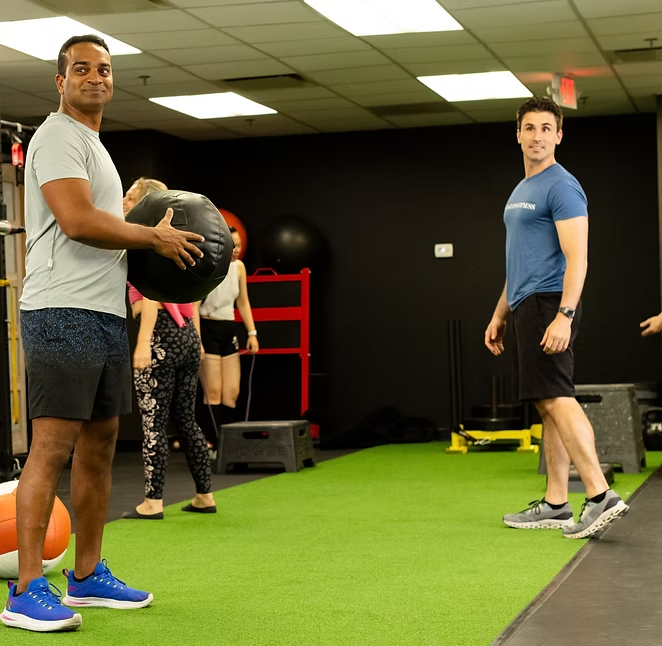
Semi-private training—small groups of 2-6 people with a dedicated coach—hits the sweet spot:
- Personalized attention without the price tag of 1-on-1
- Built-in community with people at similar stages
- Flexible scheduling that works around busy calendars
- Accountability from both the coach and the group
This is why it's become our most popular offering for Downtown Boston professionals. You get the guidance you need to train safely and effectively, the support to stay consistent, and the flexibility to make it work with your actual life.
Ready to Stop Thinking About It and Start?
You've read the articles. You know strength training is important. The question isn't whether you should do it—it's whether you'll actually start.
If you're a professional in Downtown Boston—Financial District, Back Bay, Beacon Hill, or the North End—and you're ready to get back into strength training after years off, we'd love to help.
Two ways to start:
-
Book a Free Intro Call — Chat with us about your goals, concerns, and what's held you back before. No pressure, just a conversation.
-
Try the 4-Session Booster Pack ($99) — Skip the call and just show up. Four sessions to see if we're a good fit. No commitment, no pressure.
Either way, the hardest part is the first step. Everything after that gets easier.
First Guess Fitness
30 Court Square, Downtown Boston
Book a Free Call | Try 4 Sessions
About the Author: Justin Kompf, PhD, CSCS, is a behavior-change scientist, strength coach, and co-founder of First Guess Fitness in Boston, MA. He specializes in progressive resistance training, evidence-based habit formation, and exercise psychology. Google Scholar profile.